← Back to Knowledge Hub

Non-Surgical Alternatives

5 Questions to Ask Before Choosing a PRP or Stem Cell Provider

Patient Education
See Dr. Tortland in Google and AI Search
Dr. Paul Tortland, DO, Dual-Board Certified in Sports Medicine & Regenerative Medicine
linkedinyoutubefacebook
5 Questions to Ask Before Choosing a PRP or Stem Cell Provider
Written and Medically Reviewed by Dr. Paul Tortland, DO, FAOASM, CAQSM, RMSK, Dual-Board Certified in Sports Medicine & Regenerative Medicine
·
October 18, 2026
What You Need to Know

Before choosing a PRP or stem cell provider, ask: what system/concentration they use, whether cells are autologous or commercial donor-tissue, what evidence supports it for your diagnosis, what regulatory framework applies, and what outcomes are realistic.

Where to See Dr. Tortland in Connecticut

Dr. Paul Tortland, DO provides comprehensive orthopedic evaluations for patients at his Glastonbury, CT office. The practice sees patients from Glastonbury, Hartford, West Hartford, Farmington, Simsbury, South Windsor, and other Connecticut and New England communities.

📍 59 Sycamore Street, Suite 301, Glastonbury, CT 06033 — Get directions
📞 (860) 430-2821
Learn more about Dr. Tortland · Request an evaluation

Direct Answer: Before choosing a provider for PRP or a "stem cell" treatment, ask these five questions: (1) What system do you use, and what platelet or cell concentration does it produce? (2) Are you using my own (autologous) cells, or a commercial donor-tissue product? (3) What condition-specific evidence supports this treatment for my diagnosis? (4) What regulatory framework governs this treatment, and can you explain it? (5) What outcomes can I realistically expect, including the limits of what's known?

Why These Questions Matter

As covered in earlier pieces on PRP concentration variability and the difference between real and commercial "stem cell" products, this field has significant variation in quality, transparency, and evidence — and patients are often not equipped to tell the difference on their own. A provider's willingness and ability to answer these questions clearly is itself useful information. In our practice, we often meet patients who switched providers after realizing, partway into treatment elsewhere, that they'd never been given straight answers to questions like these.

1. What System Do You Use, and What Concentration Does It Produce?

PRP concentration varies significantly between systems and providers. A provider who can name their system and describe the typical concentration it produces is demonstrating transparency worth noting.

2. Autologous or Commercial Donor Product?

Many products marketed as "stem cell therapy" use donor (allogeneic) tissue that may contain few or no living stem cells. Autologous treatments, like BMAC or MFAT, use the patient's own cells collected and processed at the point of care.

3. What Evidence Supports This for My Specific Diagnosis?

Evidence quality varies significantly by condition — for example, PRP for knee osteoarthritis is far more studied than PRP for many other applications. Ask specifically about evidence for your diagnosis, not the treatment category in general.

4. What Regulatory Framework Applies?

Autologous treatments like BMAC are governed by FDA regulations including 21 CFR Part 1271. A provider should be able to explain, in plain terms, the regulatory basis for what they're offering.

5. What Outcomes Can I Realistically Expect?

Be cautious of providers who promise specific outcomes or guarantee results. Evidence-based providers will discuss both potential benefits and the real uncertainty involved.

Dr. Tortland's Perspective

I'd rather a patient walk into my office with a list of hard questions than take any provider's word at face value — mine included. These five questions are a reasonable starting point for evaluating any provider offering PRP or stem cell-related treatments.

Limitations: What These Questions Cannot Tell You

Asking the right questions does not guarantee a good outcome — even a well-prepared, appropriately concentrated PRP or orthobiologic treatment does not work for every patient or every condition, and no reputable provider can promise a specific result. These questions are meant to help you evaluate a provider's transparency and rigor, not to serve as a substitute for an individualized assessment of whether you are a good candidate for treatment at all.

Comparison at a Glance

TreatmentMechanismDurationBest Candidate Stage
Autologous PRPConcentrated autologous platelets from the patient's own bloodTypically months per treatment; may be repeatedJoint or tendon conditions with supporting evidence for PRP
Autologous BMAC / MFATConcentrated cells from the patient's own bone marrow or fat tissueOften longer-acting than PRP; may be staged together with PRPMore advanced joint degeneration where PRP alone is insufficient
Commercial "donor" stem cell productAllogeneic tissue-derived product; may contain few or no living cellsUnclear or unprovenNot generally recommended; evidence and regulatory basis should be questioned before use

Frequently Asked Questions

What's the single most important question to ask a PRP or stem cell provider?

Whether the cells or platelets are autologous (from your own body) or a commercial donor-tissue product, and what concentration or cell count they actually verify before injecting.

Is it rude to ask a provider these questions?

No. A provider who takes regenerative medicine seriously expects and welcomes these questions — hesitation or vague answers is itself useful information.

Do these questions apply to both PRP and stem cell treatments?

Yes. The same core issues — concentration, cell source, evidence for your specific diagnosis, and regulatory compliance — apply whether you're considering PRP or a bone marrow/fat-derived treatment.

What if a provider can't answer these questions clearly?

That's a meaningful red flag. A provider who can't explain what they're using, how it's measured, or why it's appropriate for your condition may not be equipped to deliver a therapeutically effective treatment.

What credentials should I look for in a PRP or stem cell provider?

Board certification relevant to musculoskeletal care, specific training in image-guided orthobiologic injection technique, and the ability to explain their outcomes data are reasonable things to confirm before scheduling.

Is a lower price for PRP or stem cell treatment a red flag?

Not automatically, but an unusually low price combined with vague answers about preparation method, cell counts, or physician credentials is worth questioning rather than assumed to be a bargain.

Does it matter if my provider uses ultrasound guidance for the injection?

Image guidance, typically ultrasound or fluoroscopy, helps confirm accurate placement of the injection. Asking whether your provider injects under direct visualization rather than by feel alone is a reasonable question.

What if a provider gets defensive when I ask these questions?

A provider confident in their approach should be able to answer straightforward questions about credentials, preparation, and expected outcomes without defensiveness. Discomfort with reasonable questions is itself useful information.

Glastonbury, CT · Serving Connecticut & New England

Ready to Schedule? Dr. Tortland Is Accepting New Patients.

Schedule a consultation at 59 Sycamore Street, Suite 301, Glastonbury, CT 06033. No referral required.

Schedule ConsultCall (860) 430-2821
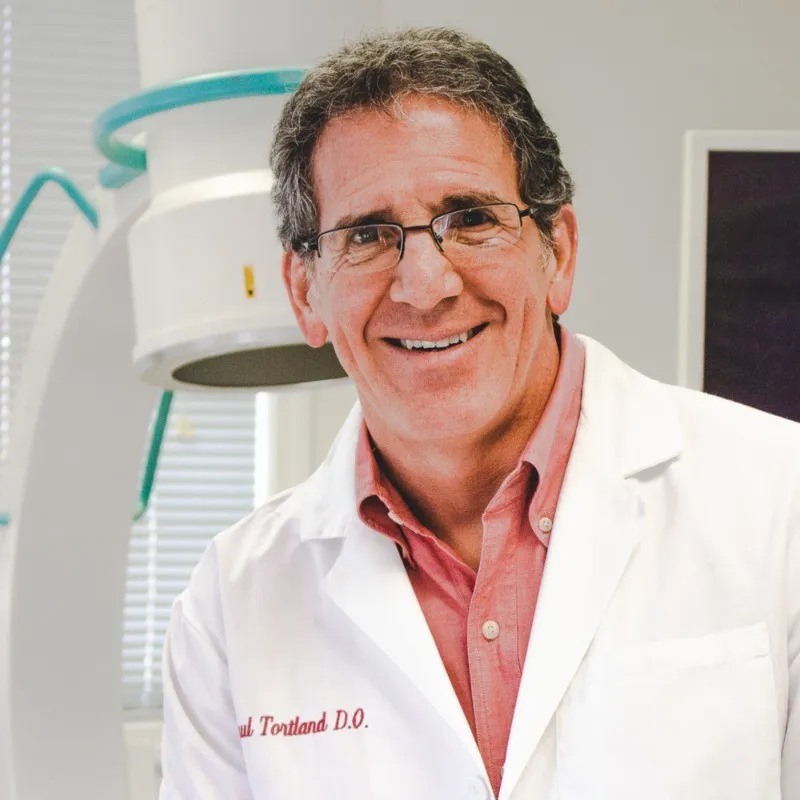
Portrait of Dr. Paul Tortland, DO

Dual-Board-Certified · Fellowship-Trained · Specialist in Regenerative Orthopedics

About Paul D. Tortland, DO

Dr. Paul Tortland was the first physician in southern New England to offer PRP and BMAC + MFAT stem cell treatments for Orthopedic injuries, treating patients since 2007 with a customized, ultrasound-guided approach and measured, high-concentration PRP preparations at his Glastonbury, CT practice.

References & Further Reading

View 1 medical reference and further reading
  • Khan ZA, Kaplan DJ, Hevesi M, et al. "The Availability and Pricing of Orthobiologic Knee Injections in the Chicago Metropolitan Area: A Market Assessment Study." Orthopaedic Journal of Sports Medicine. 2025. https://pubmed.ncbi.nlm.nih.gov/40485878/

Learn more on this site: BMAC and MFAT stem cell treatment · PRP injections in Connecticut