Platelet-rich plasma (PRP)
PRP Injections in Glastonbury, CT: Measured Platelet-Rich Plasma
High-concentration PRP, prepared specifically for you, from the physician who performed the first PRP treatments in southern New England in 2007.
Medicine is not one-size-fits-all. Neither is your PRP. A high-volume blood draw, double-spin preparation, and laboratory platelet counting create a PRP customized to your age, injury, diagnosis, and baseline platelet count. Measured before processing. Measured again after. Dose calculated before injection. Measured. Every time. No guessing.
Quick answer
Platelet-rich plasma (PRP) is a concentrated dose of a patient's own platelets and growth factors, drawn from their blood and injected under live ultrasound guidance into an injured tendon, ligament, or joint. Evidence is strongest for mild to moderate knee osteoarthritis, where randomized trials show PRP outperforming hyaluronic acid and saline, and for certain tendon conditions; results vary by diagnosis and preparation method. This practice custom-formulates PRP in an on-site lab, measuring platelet concentration before and after processing to a therapeutic target rather than relying on a one-size-fits-all bedside kit.
Definition: platelet-rich-plasma (PRP)
What PRP therapy is and how it is customized
And why not all PRP is prepared the same way.
Platelet-Rich Plasma (PRP) concentrates your own platelets to help injured or arthritic tissue heal: best for mild-to-moderate osteoarthritis, partial tears, back and neck pain, and tendinopathy. Not all PRP is the same: platelet concentration, total dose, and cellular composition vary by clinic, and most patients never learn what they actually received.
Dr. Tortland measures your baseline platelet count, sets the dose and the leukocyte profile for the tissue being treated, and measures the final preparation again before injection. Arthritis and tendon or ligament injuries are prepared differently: leukocyte-poor PRP for arthritic joints, leukocyte-rich PRP for tendons, and a platelet dose matched to the structure. In one documented bilateral knee case, 40.272 billion platelets were delivered in total, 20.136 billion per knee.
Time in office
About 75-90 minutes
Anesthesia
Local only: no sedation
Typical course
1 to 2 injections and / or annually to keep arthritis at bay
Return to work
Usually next day
First results
Weeks 4 to 10, depending on the area treated
Guidance
Live ultrasound or x-ray, always
Source material
Your own blood
Insurance
Not covered; but HSA / FSA applicable
Indications
Conditions PRP treats
Step by step
The PRP procedure, step by step
High-concentration PRP, a customized platelet count, and precise ultrasound guidance.
01
Diagnostic ultrasound first
At your initial evaluation, the joint or tendon is examined on live ultrasound so the treatment target is confirmed, not assumed. Treatment itself is typically scheduled as a separate visit.
02
Blood draw: high volume
Dr. Tortland draws 60 to 250+ mL of blood, depending on the target: chosen for the condition being treated, the patient's age, and platelet count. More starting blood means more platelets available to concentrate and measure. Most general PRP kits only require 20-60 mL of blood drawn, which is NOT acceptable for Dr. Tortland's standards.
03
Centrifugation: double spin
Your blood is spun in office with a double-spin protocol to separate and concentrate the platelet fraction. Preparation takes 30-40 minutes while you wait in the room.
04
High platelet count & customization
Your baseline platelet count is measured on a Beckman Coulter DxH 500 cell counter, and the PRP is custom-prepared with the Exo Advantage system, tailored to your injury, age, and baseline count. The preparation is targeted to a high platelet concentration relative to baseline, then measured again to verify what was actually produced, not assumed from the process alone.
05
MSK ultrasound-guided injection
The area is numbed with local anesthetic both locally AND inside the joint to ensure as painless a procedure as possible, then the needle is advanced under live MSK ultrasound and / or fluoroscopic guidance into the exact structure(s) at fault. You can watch the screen as it happens.
06
Customized Recovery Protocol
You leave with a written Recovery schedule tailored to your specific treatment plan, with potential for EMTT & ESWT and / or Physical Therapy to accelerate recovery time. Expect two to five days of initial soreness: that inflammatory response is the treatment working. No anti-inflammatories for two weeks.
07
Follow-up and re-evaluate
Follow-up within 6 weeks to 3 months with repeat ultrasound and / or an updated MRI to compare tissue appearance and patient symptom progression against baseline and decide whether a second PRP procedure adds value.
the proof - Why this matters to you
Why measuring PRP dose and concentration matters
You don't know what you don't measure.
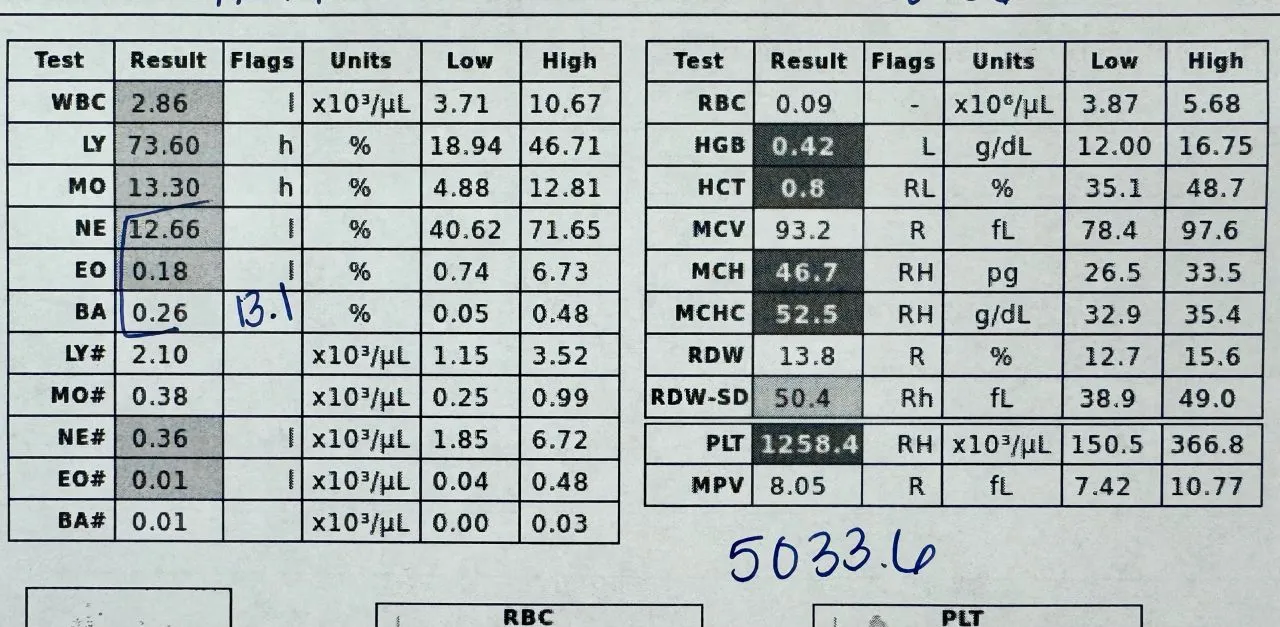
From a recent bilateral knee PRP treatment: 240 cc blood → 8 cc PRP (4 cc/knee), measured at 5,034,000 platelets/µL, 40.272 billion total, 20+ billion per knee. Bedside counters typically under-count, so the true number was likely higher.
Concentration counts. Starting platelet counts vary widely, so two patients who get "the same PRP" can end up with very different numbers of actual platelets. Dr. Tortland measures your count before and after processing on an in-lab Beckman Coulter cell counter, so he knows what was actually produced, not what a standard kit was expected to deliver. Published trials point the same way: studies with positive results delivered higher platelet doses than studies without. In one recent bilateral knee treatment, 40.272 billion platelets were delivered in total, over 20 billion to each knee. The goal is the right concentration and total dose for your tissue, measured every time.
What is platelet concentration? How densely packed the platelets are in the PRP. What is platelet dose? How many platelets are actually delivered: platelet dose equals platelet concentration times PRP volume. They're not the same number, and only one tells you what you actually received. Think of it like coffee: a strong shot packs more flavor per ounce, but a bigger mug can still deliver more caffeine overall. Dr. Tortland measures both, every time, so nothing is assumed.
Evidence
Research on PRP platelet count and dose
AAPM&R guidance, April 2026
AAPM&R's April 2026 guidance statement on PRP for knee osteoarthritis gives five evidence based recommendations and 11 consensus best practices on patient selection, platelet dose, preparation, technique, safety and informed consent. It supports considering PRP for mild to moderate knee osteoarthritis that persists despite conservative care.
Platelet dose: customized, not maximized
Concentration counts, and the right number depends on the tissue. A 2025 PM&R meta-analysis of 32 trials found PRP beat hyaluronic acid or saline at every dose studied, with 5 to 10 billion total platelets giving the largest functional gain. A 2024 review found that trials with positive results delivered higher doses than trials without (about 5.5 vs 2.3 billion platelets), and a 2025 meta-analysis found high concentration PRP gave clinically meaningful pain relief through 12 months while low concentration did not. Dr. Tortland measures concentration and total dose and sets both for the condition, rather than accepting whatever a standard kit yields.
Technique
A 2023 hematology study found double-spin centrifugation yields significantly higher platelet counts, with less red- and white-cell contamination, than a single spin: consistent with why it's used here.
Leukocyte Content
The preparation is matched to the tissue. For arthritic joints Dr. Tortland uses leukocyte-poor PRP, which scored better on IKDC outcomes in one meta-analysis (Belk 2021), although a 2026 review found the evidence too limited to say whether leukocytes change joint outcomes. For tendons he uses leukocyte-rich PRP, which gave the strongest results in a meta-analysis of 18 randomized tendinopathy trials (Fitzpatrick 2017). Ligament and spine preparations are tailored to the structure treated, and trials have not settled the best choice.
Full citations for every study on this page are listed under References & Further Reading below.
In Dr. Tortland's practice: measured, not marketed
12 to 15×
Average platelet concentration relative to baseline in the current High-Concentrate protocol
≈19×
The concentration measured in one documented case
40.272 billion
Total platelets delivered in that same 8 mL preparation, measured at 5,034,000 platelets per microliter
60 to 250+ mL
Blood volume range used, depending on treatment target and patient characteristics
DxH 500
The clinical hematology analyzer used to measure platelet counts, before and after processing
2-spin
The double-spin protocol used to separate and concentrate the platelet fraction
Why double-spin is only part of the story
A double-spin protocol concentrates platelets more precisely than a single spin. But the process alone doesn't guarantee a result: every preparation is measured and characterized before injection, not assumed from the method used.
Customization
PRP for arthritis versus tendon and ligament injuries
PRP is customized by tissue. Arthritic joints and tendons respond to different preparations, so Dr. Tortland sets the leukocyte content, volume and platelet dose for the structure being treated, then measures the result before injection.
Comparison
PRP compared with cortisone, gel injections, stem cells and surgery
PRP or cortisone? Cortisone can calm pain quickly, but relief usually fades within weeks to a few months, and repeated injections can weaken tendon and cartilage. PRP takes longer to work, typically 4 to 10 weeks depending on the area treated, and aims to improve the tissue itself. In patients who respond, benefit often lasts 6 to 12 months or longer, and arthritis may need a repeat treatment about once a year. When a joint or tendon is beyond repair, surgery is the right answer, and Dr. Tortland will tell you so.
Candidacy
Who is and is not a candidate for PRP
PRP works best as an honest fit, not a guarantee: candidacy is judged on what live ultrasound actually shows, not hope or marketing claims.
See how we help you honestly weigh surgery vs. non-surgical care →A patient's checklist
Questions to ask before choosing PRP
- What was my baseline platelet count?
- Do you measure the platelets, or rely on the kit's expected yield?
- What was the final platelet concentration?
- What was the total platelet dose delivered?
- Was the preparation single-spin or double-spin?
- What was the leukocyte content?
- Why was this particular preparation chosen for my condition?
- Was the injection performed under live ultrasound or fluoroscopic guidance?
If you don't know what was measured, you don't fully know what was injected.
Frequently asked questions
What are the most common questions about PRP therapy?
Does PRP actually work?
Is all PRP the same?
How painful is a PRP injection?
How long does PRP take to work?
How many PRP injections will I need?
Is PRP covered by insurance?
How long will a PRP injection last?
Is PRP the same as stem cell therapy?
Who performs the injection?
Sources
Sources
01
Mulvaney SW, Tortland PD, Shiple B, Curtis K. Regenerative medicine options for chronic musculoskeletal conditions: a review of the literature. Endurance and Sports Medicine. 2018.
07
AAPM&R Orthobiologic Technical Expert Panel. AAPM&R guidance statement on platelet rich plasma for knee osteoarthritis. PM&R. 2026;18(Suppl 2):S20-S35.
08
Berrigan WA, Bailowitz Z, Park A, Reddy A, Liu R, Lansdown D. A Greater Platelet Dose May Yield Better Clinical Outcomes for Platelet-Rich Plasma in the Treatment of Knee Osteoarthritis: A Systematic Review. Arthroscopy. 2025;41(3):809-817.e2.
09
Hooper N, Shapiro S, Paidsetty V, Azarpey A, Jindal A, Mautner K, Easley K, Buford D, Sussman W, Jayaram P. Platelet-Rich Plasma Outcomes in Knee Osteoarthritis Are Associated With the Amount of Total Deliverable Platelets: A Systematic Review and Meta-analysis. PM R. 2025.
10
Saqlain N, Mazher N, Fateen T, Siddique A. Comparison of Single and Double Centrifugation Methods for Preparation of Platelet-Rich Plasma (PRP). Pak J Med Sci. 2023;39(3):634-637.
11
Fitzpatrick J, Bulsara M, Zheng MH. The effectiveness of platelet-rich plasma in the treatment of tendinopathy: a meta-analysis of randomized controlled clinical trials. Am J Sports Med. 2017;45(1):226-233.
12
Bensa A, Previtali D, Sangiorgio A, Boffa A, Salerno M, Filardo G. PRP injections for the treatment of knee osteoarthritis: the improvement is clinically significant and influenced by platelet concentration: a meta-analysis of randomized controlled trials. Am J Sports Med. 2025;53(3):745-754.
13
Martín-Vega M, Gómez-Carrión Á, Zaragoza-García I, Ortuño-Soriano I, Marcelino-Argemi A, Sanz-Wozniak P, Saludes-Llamas R, Sánchez-Gómez R. Leukocyte-rich versus leukocyte-poor platelet-rich plasma for osteoarthritis: a systematic review. Regen Ther. 2026;31:101078.
14
Bennell KL, Paterson KL, Metcalf BR, et al. Effect of intra-articular platelet-rich plasma vs placebo injection on pain and medial tibial cartilage volume in patients with knee osteoarthritis: the RESTORE randomized clinical trial. JAMA. 2021;326(20):2021-2030.
15
Unlu MC, Kivrak A, Kayaalp ME, Birsel O, Akgun I. Peritendinous injection of platelet-rich plasma to treat tendinopathy: a retrospective review. Acta Orthop Traumatol Turc. 2017;51(6):482-487.
16
Playfair D, Smith A, Burnham R. An evaluation of the effectiveness of platelet rich plasma epidural injections for low back pain suspected to be of disc origin: a pilot study with one-year follow-up. Interv Pain Med. 2024;3(2):100403.
Find out whether PRP fits your condition
Candidacy for PRP is determined on ultrasound, not over the phone. Bring your imaging and get an honest answer in one visit.