Direct answer: Platelet-rich plasma (PRP) has evidence-supported roles in rotator cuff care, but the role depends on the type of problem. For rotator cuff tendinopathy and partial-thickness tears, PRP injections are used without surgery to reduce pain and improve function. For full-thickness tears repaired surgically, several meta-analyses link PRP added during repair to lower retear rates, although the improvements in pain and function scores have generally been small. PRP is not a substitute for surgery in every case, and a careful ultrasound evaluation determines which path fits each patient.
Understanding Rotator Cuff Tears and Tendinopathy
The rotator cuff is a group of four muscles and their tendons that stabilize the shoulder and allow it to lift, rotate, and reach overhead. Problems in this area exist on a spectrum. At one end is rotator cuff tendinopathy, where the tendon is irritated, thickened, or degenerated but still structurally intact. Further along are partial-thickness tears, where some but not all of the tendon fibers are torn. At the far end are full-thickness tears, where the tendon is torn all the way through.
This distinction matters for treatment planning. Tendinopathy and partial tears often respond to a structured non-surgical approach. Full-thickness tears, particularly larger or retracted ones, more often require surgical repair, though PRP may still play a supporting role.
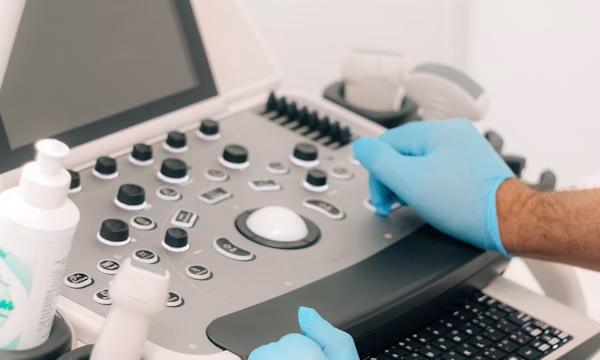
Diagnosis starts with a detailed history and physical exam, but real clarity comes from imaging. In our office, every new patient's evaluation includes a live musculoskeletal ultrasound exam in the same visit, so we can see the tendon fibers directly, measure any tear, and assess the surrounding tissue without sending the patient elsewhere and waiting days for answers.
Who May Benefit From PRP for the Rotator Cuff
Based on current evidence, PRP tends to be most appropriate for:
- Patients with rotator cuff tendinopathy who have not responded adequately to rest, activity modification, and a supervised physical therapy program
- Patients with low-grade partial-thickness tears who want to avoid or delay surgery and whose tear pattern is favorable
- Patients undergoing arthroscopic repair of a full-thickness tear, where their surgeon may use PRP during the operation as an adjunct
- Patients who tried a corticosteroid injection with limited or short-lived benefit and want to explore a regenerative option before considering surgery
PRP is generally a poorer fit for large, retracted full-thickness tears that need surgical repair to restore strength, and for shoulders with significant muscle atrophy or fatty infiltration, where the biology of healing works against recovery.
What the Current Evidence Shows
The research on PRP and the rotator cuff falls into two distinct bodies of evidence, and it is important not to blend them.
PRP as a non-surgical injection for tendinopathy and partial tears. A systematic review and meta-analysis of 8 randomized trials (A Hamid and Sazlina, 2021) found PRP injection to be safe and effective for long-term pain control and shoulder function in patients with rotator cuff disorders. The studies varied in how PRP was prepared and what it was compared against, including saline, rehabilitation, and dry needling, which is part of why we set realistic expectations rather than promising a specific result.
PRP as a surgical adjunct for full-thickness tear repair. A meta-analysis of 10 randomized trials with 628 patients (Peng et al., 2023) found that adding PRP during arthroscopic repair reduced retear rates and modestly improved function scores, but the functional differences fell below the threshold patients typically notice. A 2025 meta-analysis focused on leukocyte-poor PRP (Hovland et al.; 9 trials, 743 patients) found about a 46% relative reduction in retears, again without clinically meaningful changes in pain or patient-reported outcomes. Not every analysis agrees: a 2025 meta-analysis of 9 trials (Xue et al.) found no significant difference in pain, function, complications, or retear rate for full-thickness tears. The fairest summary is that PRP may help protect a surgical repair structurally, but it does not reliably make recovery more comfortable, and the evidence is still being refined.
PRP quality is not standardized between providers. Concentration, preparation method, and the number of platelets actually delivered vary widely. In our practice, PRP is prepared to roughly 12 to 15 times a patient's baseline platelet level, and every treatment is delivered under real-time ultrasound guidance.
When Non-Surgical Care May Be Appropriate
For rotator cuff tendinopathy, most low-grade partial-thickness tears, and shoulders where imaging shows preserved tendon quality and minimal retraction, a non-surgical pathway is often reasonable to try first. This typically combines a structured physical therapy program targeting shoulder mechanics and scapular stability with, when appropriate, an ultrasound-guided PRP injection. Non-surgical care is also sensible for patients who are not good surgical candidates for other medical reasons.
When Surgery May Be More Appropriate
Surgery is more likely to be the better path when a tear is large or full-thickness with significant retraction, when weakness limits daily function, when imaging shows early muscle atrophy or fatty infiltration (which tends to worsen the longer a large tear goes unrepaired), or when a reasonable course of non-surgical care has not helped. In these situations, timely referral to an orthopedic surgeon is the responsible recommendation.
What PRP Does Not Do for the Rotator Cuff
- It does not reliably heal a large, full-thickness, or retracted tear without surgery.
- It is not a substitute for surgical repair when repair is genuinely the better option.
- When used during surgery, it has not consistently produced meaningful improvements in pain or patient-reported function, even where retear rates improved.
- It does not guarantee results. Response varies, and benefit is not necessarily permanent.
- It does not replace rehabilitation, which remains central to recovery.
- Candidacy depends on an accurate diagnosis, including ultrasound assessment of the tendon.
Dr. Tortland's Perspective
My approach to every shoulder patient follows the same philosophy I apply across our practice: Validate, Investigate, Regenerate. I start by validating that the pain a patient describes is real. I investigate thoroughly, with a hands-on exam and a live diagnostic ultrasound in the same visit, so decisions are based on what the tendon actually looks like. When the findings support it, we move toward regenerative options like PRP.
I am not in the business of selling procedures to every patient who walks in the door. When the imaging and exam point toward a large or retracted tear that needs a surgeon, I say so directly and refer the patient, because that is the better path for that person. PRP has a legitimate place in rotator cuff care; the key is matching the right tool to the right shoulder.
Related Questions
- Can calcific tendinitis be treated without surgery?
- Why does PRP preparation vary between providers?
- What can PRP realistically do?
- Non-surgical shoulder treatment options
Next Steps
If you are dealing with shoulder pain and want to know whether your rotator cuff would respond to PRP, rehabilitation, or whether surgery is the better route, start with a comprehensive evaluation that includes a live ultrasound assessment of the tendon. Schedule a consultation to get a clear, evidence-based picture of your options.
References
- A Hamid MS, Sazlina SG. Platelet-rich plasma for rotator cuff tendinopathy: A systematic review and meta-analysis. PLoS One. 2021;16(5):e0251111. doi:10.1371/journal.pone.0251111
- Peng Y, et al. Efficacy of platelet-rich plasma and platelet-rich fibrin in arthroscopic rotator cuff repair: A systematic review and meta-analysis. PM R. 2023;15(12):1643-1653. doi:10.1002/pmrj.13049
- Hovland S, et al. Perioperative Leukocyte-Poor Platelet-Rich Plasma Associated With Reduced Risk of Retear After Arthroscopic Rotator Cuff Repairs: A Systematic Review and Meta-analysis. Arthroscopy. 2025;41(11):4762-4771. doi:10.1016/j.arthro.2025.05.015
- Xue X, et al. Arthroscopic Surgery Combined With Platelet-Rich Plasma Does Not Significantly Improve Pain, Function, Complications, and Retear Rate Compared With Arthroscopic Surgery Alone for Full-Thickness Rotator Cuff Tears. Arthroscopy. 2025;41(2):289-301. doi:10.1016/j.arthro.2024.03.024