What You Need To Know
- Bone marrow lesions (BMLs) — zones of stress and inflammation inside the bone beneath damaged cartilage — are strongly linked to knee osteoarthritis pain and progression, independent of how the cartilage itself looks on imaging.
- Intraosseous (IO) injection delivers PRP or bone marrow concentrate directly into the bone through a small drilled access channel, rather than into the joint space.
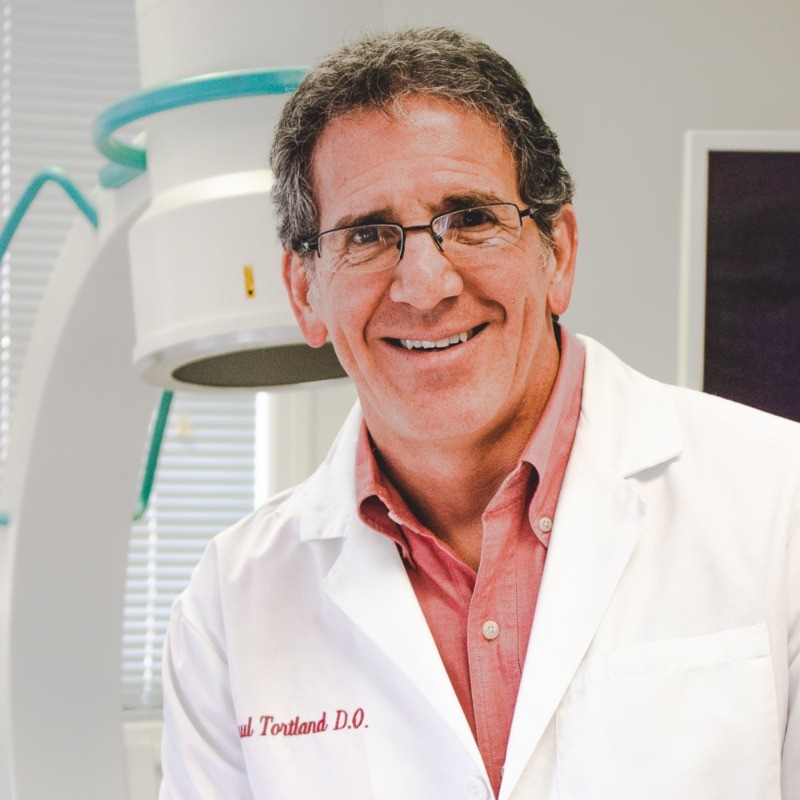
- Dr. Tortland has personally performed fluoroscopy-guided intraosseous PRP injections for bone marrow lesions in the medial femoral condyle and tibial plateau in patients with advanced knee OA.
- The technique is still early-stage in the research, with promising short-to-mid-term results from multiple groups — and at least one study finding no added benefit over intra-articular injection alone, which is worth knowing before assuming IO is always the right add-on.
The problem with treating only the joint space
Most patients think of PRP and stem cell injections going into the joint. But in a lot of advanced osteoarthritis cases, the more important target is sitting just underneath the cartilage, inside the bone itself: a bone marrow lesion. These show up on MRI as areas of edema and biologic stress in the subchondral bone, and the research consistently ties them to how much pain a patient reports and how fast their arthritis progresses — sometimes more strongly than the cartilage damage itself. An intra-articular injection alone doesn't reach that tissue. If there's an active BML underneath the joint you're treating, you're addressing half the problem.
New instrumentation, same underlying technique
Access to the lesion requires drilling a small cortical window and delivering PRP or bone marrow aspirate concentrate directly into the bone marrow, typically under fluoroscopic or ultrasound guidance, using local anesthesia in an outpatient procedure room. Standard intraosseous/bone marrow needles from major suppliers have been backordered industry-wide for an extended stretch, which pushed Dr. Tortland to trial and demonstrate newer instrumentation — the Cervos surgical drill system — for IO access and BMA/C aspiration, which he's shown in a hands-on video demonstration after using it clinically for fluoro-guided intraosseous PRP injections in the medial femoral condyle and tibial plateau for a patient with advanced knee OA.
What the research shows so far
The technique traces back to Spanish researcher Mikel Sánchez, whose group published some of the first clinical series combining intraosseous and intra-articular PRP for severe knee OA and reported meaningful improvement in pain and function. Philippe Hernigou's long-running work on bone marrow concentrate dosing has shown a similar pattern — and in some cohorts, delayed the need for knee replacement by years. A 2021 systematic review across the available studies concluded that knee intraosseous injections are minimally invasive, safe, and produce real short-term benefit, while also being clear that larger, longer-term trials are still needed. Not every study agrees: one comparative study found intraosseous bone marrow concentrate and platelet products added to intra-articular injection did not improve patient-reported outcomes over intra-articular injection alone — a fair limitation to acknowledge rather than gloss over.
Why dosing matters as much as technique
A recurring theme from Dr. Tortland's talks at Interventional Orthobiologics Foundation (IOF/TOBI) conferences: the technique only works if the dose is right. He's drawn a direct line back to the earliest hematology/oncology research establishing minimum cell-dosing standards for bone marrow rescue therapy — standards that were treated as non-negotiable because falling short of them cost lives — and pointed out that Hernigou's orthopedic research on bone marrow concentrate shows the same dose-response pattern for musculoskeletal regeneration: injections with too low a cell dose simply don't work as well. The same principle is now being established for platelet dosing in PRP. In practice, that means a clinic's centrifuge and processing protocol matter as much as whether they offer the injection at all.
Teaching the technique forward
Dr. Tortland has hosted and trained visiting international fellows on intraosseous injection technique directly in his practice — including a fellow who, by Dr. Tortland's own account, went on to perform the first-ever intraosseous injection at his hospital in Lisbon based on what he'd learned during that training. He also delivered a dedicated lecture with a full literature review on bone marrow lesion treatment at the Regenerative Medicine Training Institute (June 2019), which remains part of that organization's physician education curriculum.
Research
- Sánchez M, Delgado D, Sánchez P, et al. Combination of intra-articular and intraosseous injections of platelet rich plasma for severe knee osteoarthritis: a pilot study. BioMed Res Int. 2016. PubMed
- Sánchez M, Delgado D, Pompei O, et al. Treating severe knee osteoarthritis with combination of intra-osseous and intra-articular infiltrations of platelet-rich plasma: an observational study. Cartilage. 2019;10(2):245-253. PubMed
- Delgado D, Garate A, Hunter V, et al. Current concepts in intraosseous platelet-rich plasma injections for knee osteoarthritis. J Clin Orthop Trauma. 2019;10:36-41. PMC
- Hernigou P, Bouthors C, Bastard C, et al. Subchondral bone or intra-articular injection of bone marrow concentrate mesenchymal stem cells in bilateral knee osteoarthritis: what better postpone knee arthroplasty at fifteen years? A randomized study. Int Orthop. 2021;45:391-399. PubMed
- Di Matteo B, Polignano A, Onorato F, et al. Knee Intraosseous Injections: A Systematic Review of Clinical Evidence of Different Treatment Alternatives. Cartilage. 2021. Journal
- The Treatment of Bone Marrow Lesions Associated with Advanced Knee Osteoarthritis: Comparing Intraosseous and Intraarticular Injections with Bone Marrow Concentrate and Platelet Products. PubMed. PubMed
- Intraosseous Treatment of Bone Marrow Lesions in the Knee: Surgical Technique (WALANT approach). PMC, 2024. PMC