What Is ESWT and How Does It Treat Plantar Fasciitis?
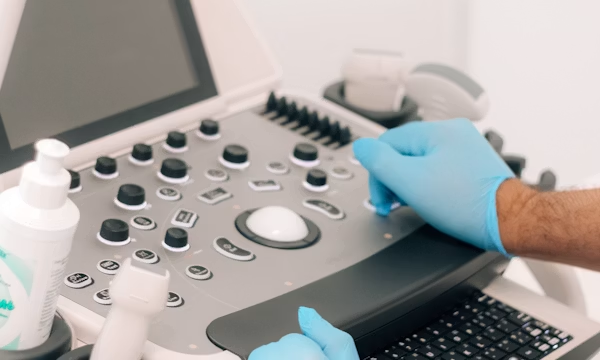
Extracorporeal shockwave therapy (ESWT) is a non-invasive treatment that delivers focused acoustic pulse waves through the skin to the affected area of the heel and plantar fascia. The mechanical energy from these pulses is thought to stimulate a localized healing response in chronically irritated tissue — essentially prompting the body to treat a stubborn, stalled injury as a fresh one worth repairing. Unlike surgery, ESWT requires no incision, no anesthesia beyond the treatment sensation itself, and no meaningful recovery period.
Plantar fasciitis is one of the most common causes of heel pain, and for most patients it responds well to conservative treatment: activity modification, night splints, supportive orthotics, and a structured physical therapy program. ESWT is typically introduced when heel pain has persisted for several months despite these more basic measures — it is a second-line option, not a replacement for trying conservative care first.
What Does the Research Say About ESWT's Effectiveness?
A comprehensive narrative review examining ESWT across a range of chronic pain conditions, including plantar fasciitis, found consistent evidence supporting its use as an effective, low-risk option once simpler treatments have been exhausted. The review highlighted that ESWT's mechanism — stimulating neovascularization and modulating pain signaling in chronically inflamed tissue — is reasonably well understood, even though outcomes can vary based on the specific protocol, equipment, and patient selection used.
It's worth being direct about the limits of this evidence: not every study of ESWT shows dramatic results, and some research on shockwave therapy for other conditions has found it performs similarly to, rather than clearly better than, other non-surgical treatments. The honest summary is that ESWT is a legitimate, well-supported option for plantar fasciitis specifically, not a guaranteed fix for every type of chronic tendon or fascia pain.
How Many ESWT Sessions Are Typically Needed?
Most treatment protocols call for 6 or more sessions, typically given once or twice a week. A single session takes about 15 minutes, during which the patient feels a rapid tapping sensation as the device is applied to the skin. Some patients notice improvement after just one or two sessions, but the fuller benefit generally develops over the course of the complete protocol.
Am I a Good Candidate for ESWT?
The best candidates for ESWT are patients who have already given conservative care — stretching, orthotics, night splints, physical therapy — a genuine trial of at least several weeks to months without adequate relief. Patients with very acute, recent-onset heel pain are typically better served by continuing conservative measures first, since plantar fasciitis often improves on its own within this window. ESWT tends to be most useful for the subset of patients whose pain has become chronic and treatment-resistant.
What Are the Risks of ESWT?
ESWT is considered a low-risk procedure. The most common side effects are temporary soreness, mild bruising, or redness at the treatment site, which typically resolve within a few days. Because no anesthesia or incision is involved, the risk profile is substantially lower than that of surgical treatment for plantar fasciitis, such as plantar fascia release.
Is ESWT Only Used for Plantar Fasciitis?
No. ESWT is also used for a range of other chronic tendon and soft-tissue conditions, including Achilles tendinitis, tennis and golfer's elbow, shoulder tendinitis, and hamstring strains — essentially any chronic, treatment-resistant tendon injury where the goal is to restart a stalled healing process without surgery.
Reference
According to PubMed: Ufondu W, Ogunsola O, Williams A, Valenti K, Herbert G, Ezenekwe E, Bufano J, Suleiman T, Esiso F, Jevotovsky D, Hasoon J, Orhurhu V. Extracorporeal Shockwave Therapy in Pain Management: An In-Depth Narrative Review. Orthop Rev (Pavia). 2026. DOI: 10.52965/001c.154361